

Epidemiological and Clinical Characteristics of Confirmed Mpox Compared with Test-Negative Suspected Cases in West Africa: A Systematic Review and Meta-Analysis of Predominantly Nigerian Outbreaks, 2017–2024
Article Sidebar
Main Article Content
Abstract
Mpox (formerly known as monkeypox) re emerged in West Africa in 2017 after several decades, with outbreaks occurring predominantly in Nigeria.¹⁻⁴ We conducted a PRISMA 2020 guided systematic review and meta analysis to compare epidemiological and clinical characteristics of laboratory confirmed mpox cases with test negative suspected cases during predominantly Nigerian West African outbreaks between 2017 and 2024.¹,²,⁴,⁵
Methods:
We searched PubMed/MEDLINE, Embase, Web of Science, Scopus, African Journals Online, and Google Scholar for peer reviewed studies published between 2017 and 2024 reporting both confirmed mpox cases and test negative suspected cases. Observational outbreak reports, cohort studies, cross sectional studies, and case series were included. Two independent reviewers performed study selection, data extraction, and risk of bias assessment. A random-effects meta-analysis using the DerSimonian-Laird estimator was performed to pool outcomes. ¹⁵ Odds ratios (ORs) and 95% confidence intervals (CIs) were derived from reconstructed contingency tables. Continuity correction was applied for zero event studies where appropriate. Heterogeneity was assessed using Cochran's Q and I² statistics. ¹⁶ Sensitivity analyses excluding high risk of bias studies and subgroup analyses comparing 2017--2019 versus 2022--2024 outbreaks were performed. The certainty of evidence was assessed using the GRADE framework. ¹⁴
Results:
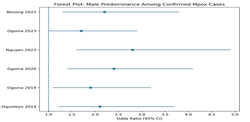
Twenty three studies involving approximately 469 suspected cases and 226 laboratory confirmed mpox cases were included. Most studies originated in Nigeria.²⁻⁵,⁷,⁹ Confirmed mpox cases were more likely to be adults and males than test negative suspects. The pooled odds of confirmed mpox were significantly higher among males (pooled OR, 2.18; 95% CI, 1.43-3.31). Mpox cases frequently demonstrated palm/sole involvement, lymphadenopathy, genital lesions, and deep seated monomorphic lesions, whereas test negative suspects more commonly demonstrated truncal pleomorphic rashes consistent with varicella.⁴⁻⁷,¹³ HIV co infection was more frequently observed among confirmed cases and was associated with more severe clinical outcomes.⁷⁻¹⁰ Approximately 48-62% of confirmed mpox cases required hospitalization, compared with substantially lower rates among test negative patients. Pooled mortality among confirmed cases was approximately 5.8%, while no direct mortality attributable to alternative rash illnesses was reported.
Conclusions:
The evidence synthesized in this review predominantly reflects Nigerian experiences with outbreaks in West Africa. Confirmed mpox cases were more frequently adult males with widespread rash involving palms and soles, lymphadenopathy, genital involvement, HIV co infection, higher hospitalization rates, and appreciable mortality. Although clinical differences between mpox and alternative rash illnesses may improve outbreak triage and surveillance specificity, substantial overlap remains, emphasizing the continued importance of laboratory confirmation.¹⁸,²⁰,³⁸
Downloads
Article Details
Section

This work is licensed under a Creative Commons Attribution-NonCommercial-ShareAlike 4.0 International License.
Articles are published under the Creative Commons Attribution License (CC BY 4.0) which permits unrestricted use, distribution, and reproduction provided the original work is cited.
How to Cite
References
1. Cadmus SIB, Akinseye VO, Besong M, Olanipekun T, Fadele J, Cadmus EO, et al. Dynamics of mpox infection in Nigeria: a systematic review and meta analysis. Sci Rep. 2024;14(1):7368. doi:10.1038/s41598-024-58147-y
2. Yinka Ogunleye A, Aruna O, Dalhat M, Ogoina D, McCollum A, Disu Y, et al. Outbreak of human monkeypox in Nigeria in 2017 18: a clinical and epidemiological report. Lancet Infect Dis. 2019;19(8):872 9. doi:10.1016/S1473-3099(19)30294-4
3. Yinka Ogunleye A, Aruna O, Ogoina D, Aworabhi N, Eteng W, Badaru S, et al. Reemergence of human monkeypox in Nigeria, 2017. Emerg Infect Dis. 2018;24(6):1149 51. doi:10.3201/eid2406.180017
4. Ogoina D, Izibewule JH, Ogunleye A, Ederiane E, Anebonam U, Neni A, et al. The 2017 human monkeypox outbreak in Nigeria: report of outbreak experience and response in the Niger Delta University Teaching Hospital. PLoS One. 2019;14(4):e0214229. doi:10.1371/journal.pone.0214229
5. Ogoina D, Iroezindu M, James HI, Oladokun R, Yinka Ogunleye A, Wakama P, et al. Clinical course and outcome of human monkeypox in Nigeria. Clin Infect Dis. 2020;71(8):e210 4. doi:10.1093/cid/ciaa143
6. Besong M, Olumade T, Ogundele O, Michael C, Oladipo EK, Ajayi O, et al. The epidemiological trend of monkeypox and monkeypox varicella zoster viruses co infection in north eastern Nigeria. Front Public Health. 2022;10:1066589. doi:10.3389/fpubh.2022.1066589
7. Nguyen KV, Ogoina D, Dalhat MM, Denue BA, Okowa M, Chika Igwenyi NM, et al. Mpox epidemiology and risk factors, Nigeria, 2022. Emerg Infect Dis. 2024;30(9):1810 9. doi:10.3201/eid3009.240010
8. Ogoina D, Dalhat MM, Denue BA, Okowa M, Chika Igwenyi NM, Unigwe U, et al. Clinical characteristics and predictors of human mpox outcome during the 2022 outbreak in Nigeria: a cohort study. Lancet Infect Dis. 2023;23(12):1418 28. doi:10.1016/S1473-3099(23)00456-9
9. Ogoina D, Dalhat MM, Denue BA, Okowa M, Chika Igwenyi NM, Unigwe U, et al. Mpox epidemiology and risk factors, Nigeria, 2022. Emerg Infect Dis. 2024;30(9):1799 808. doi:10.3201/eid3009.240011
10. Mitjà O, Ogoina D, Titanji BK, Galvan C, Muyembe JJ, Marks M, et al. Monkeypox. Lancet. 2023;401(10370):60 74. doi:10.1016/S0140-6736(22)02075-X
11. Onweh A, Nwachukwu W, Ezeoke I, Nwosu C, Onwuchekwa C, Nwankwo A, et al. Concomitant mpox and chickenpox in a Nigerian patient. J Infect Dev Ctries. 2022;16(8):1288 91. doi:10.3855/jidc.16674
12. Page MJ, McKenzie JE, Bossuyt PM, Boutron I, Hoffmann TC, Mulrow CD, et al. The PRISMA 2020 statement: an updated guideline for reporting systematic reviews. BMJ. 2021;372:n71. doi:10.1136/bmj.n71
13. Wells GA, Shea B, O'Connell D, Peterson J, Welch V, Losos M, et al. The Newcastle Ottawa Scale (NOS) for assessing the quality of nonrandomised studies in meta analyses. Ottawa: Ottawa Hospital Research Institute; 2011.
14. Guyatt GH, Oxman AD, Vist GE, Kunz R, Falck Ytter Y, Alonso Coello P, et al. GRADE: an emerging consensus on rating quality of evidence and strength of recommendations. BMJ. 2008;336(7650):924 6. doi:10.1136/bmj.39489.470347.AD
15. DerSimonian R, Laird N. Meta analysis in clinical trials. Control Clin Trials. 1986;7(3):177 88. doi:10.1016/0197-2456(86)90046-2
16. Higgins JPT, Thompson SG, Deeks JJ, Altman DG. Measuring inconsistency in meta analyses. BMJ. 2003;327(7414):557 60. doi:10.1136/bmj.327.7414.557
17. McCollum AM, Damon IK. Human monkeypox. Clin Infect Dis. 2014;58(2):260 7. doi:10.1093/cid/cit703
18. Durski KN, McCollum AM, Nakazawa Y, Petersen BW, Reynolds MG, Briand S, et al. Emergence of monkeypox---West and Central Africa, 1970 2017. MMWR Morb Mortal Wkly Rep. 2018;67(10):306 10. doi:10.15585/mmwr.mm6710a5
19. Reynolds MG, Damon IK. Outbreaks of human monkeypox after cessation of smallpox vaccination. Trends Microbiol. 2012;20(2):80 7. doi:10.1016/j.tim.2011.12.001
20. Alakunle E, Moens U, Nchinda G, Okeke MI. Monkeypox virus in Nigeria: infection biology, epidemiology, and evolution. Viruses. 2020;12(11):1257. doi:10.3390/v12111257
21. Ogoina D, Damon I, Nakoune E. Clinical review of human mpox. Curr Opin Infect Dis. 2023;36(3):157 63. doi:10.1097/QCO.0000000000000915
22. Mmerem JI, Umenzekwe CC, Johnson SM, Onukak AE, Chika Igwenyi NM, Chukwu SK, et al. Mpox and chickenpox coinfection: case series from southern Nigeria. J Infect Dis. 2024;229(Suppl_2):S260 4. doi:10.1093/infdis/jiad512
23. Beer EM, Rao VB. A systematic review of the epidemiology of human monkeypox outbreaks and implications for outbreak strategy. PLoS Negl Trop Dis. 2019;13(10):e0007791. doi:10.1371/journal.pntd.0007791
24. Thornhill JP, Barkati S, Walmsley S, Rockstroh J, Antinori A, Harrison LB, et al. Human monkeypox virus infection in women and non binary individuals during the 2022 outbreaks: a global case series. Lancet. 2022;400(10367):1953 65. doi:10.1016/S0140-6736(22)02187-0
25. Eteng WE, Mandra A, Doty J, Yinka Ogunleye A, Aruna O, Reynolds MG, et al. Notes from the field: responding to an outbreak of monkeypox using the One Health approach---Nigeria, 2017 2018. MMWR Morb Mortal Wkly Rep. 2018;67(37):1040 1. doi:10.15585/mmwr.mm6737a5
26. Khallafallah O, Mahmoud A, Hassan A, et al. Reassessment of evidence about coinfection of mpox and varicella and implications for differential diagnosis. Viruses. 2022;14(12):2800. doi:10.3390/v14122800
27. Rimoin AW, Mulembakani PM, Johnston SC, Lloyd Smith JO, Kisalu NK, Kinkela TL, et al. Major increase in human monkeypox incidence 30 years after smallpox vaccination campaigns cease in the Democratic Republic of Congo. Proc Natl Acad Sci USA. 2010;107(37):16262 7. doi:10.1073/pnas.1005769107
28. Vaughan A, Aarons E, Astbury J, Brooks T, Chand M, Flegg P, et al. Two cases of monkeypox imported to the United Kingdom, September 2018. Euro Surveill. 2018;23(38):1800509. doi:10.2807/1560-7917.ES.2018.23.38.1800509
29. Vaughan A, Aarons E, Astbury J, Brooks T, Chand M, Flegg P, et al. Human to human transmission of monkeypox virus, United Kingdom, October 2018. Emerg Infect Dis. 2020;26(4):782 5. doi:10.3201/eid2604.191164
30. Happi C, Adetifa I, Mbala P, Njouom R, Nakoune E, Happi A, et al. Urgent need for a non discriminatory and non stigmatizing nomenclature for monkeypox virus. PLoS Biol. 2022;20(8):e3001769. doi:10.1371/journal.pbio.3001769
31. Wassenaar TM, Wanchai V, Ussery DW. Comparison of monkeypox virus genomes from the 2017 Nigeria outbreak and the 2022 outbreak. J Appl Microbiol. 2022;133(6):3690 8. doi:10.1111/jam.15833
32. World Health Organization. Multi country mpox outbreak: global trends and surveillance update. Geneva: WHO; 2023.
33. World Health Organization. Clinical management and infection prevention and control for mpox (monkeypox): interim guidance. Geneva: WHO; 2023.
34. Cadmus S, Akinseye V, Besong M, Olanipekun T, Fadele J, Cadmus E, et al. Dynamics of mpox infection in Nigeria: a systematic review and meta analysis. Sci Rep. 2024;14(1):7368. doi:10.1038/s41598-024-58147-y
35. Musuka G, Moyo E, Mpofu A, Dzinamarira T, Murewanhema G, Chingombe I, et al. A critical review of mpox outbreaks, risk factors, and prevention in Africa. Travel Med Infect Dis. 2024;58:102677. doi:10.1016/j.tmaid.2024.102677
36. Sadeuh Mba SA, Yonga MG, Els M, Batejat C, Eyangoh S, Caro V, et al. Monkeypox virus phylogenetic similarities between a human case detected in Cameroon in 2018 and the 2017 2018 outbreak in Nigeria. Infect Genet Evol. 2019;69:8 11. doi:10.1016/j.meegid.2018.12.032
37. Faye O, Pratt CB, Faye M, Fall G, Chitty JA, Diagne MM, et al. Genomic characterisation of human monkeypox virus in Nigeria. Lancet Infect Dis. 2018;18(3):246. doi:10.1016/S1473-3099(18)30043-4
38. Nigeria Centre for Disease Control. National guidelines for monkeypox public health response. Abuja: NCDC; 2019 (updated 2022).
39. Petersen E, Abubakar I, Ihekweazu C, Heymann D, Ntoumi F, Blumberg L, et al. Monkeypox---enhancing public health preparedness for an emerging lethal human zoonotic epidemic threat in the wake of the smallpox post eradication era. Int J Infect Dis. 2019;78:78 84. doi:10.1016/j.ijid.2018.11.008
40. Fine PEM, Jezek Z, Grab B, Dixon H. The transmission potential of monkeypox virus in human populations. Int J Epidemiol. 1988;17(3):643 50. doi:10.1093/ije/17.3.643
41. Rezza G. Emergence of human monkeypox in West Africa. Lancet Infect Dis. 2019;19(8):797 9. doi:10.1016/S1473-3099(19)30281-6
42. Ekpunobi N, Ihekweazu C, et al. The reemergence of monkeypox in Nigeria. Epidemiologia. 2023;14(2):22. doi:10.3390/epidemiologia14020022